Friday, July 15, 2016

English Passengers – Mathew Kneale


"Strange articles of passengers they were, too. Truly, you never did see such a clever and pestful trio as these, all disagreeing with themselves and taking their great clever brains for a little stroll about the deck. I dare say it was hardly a surprise they were odds, mind, seeing as their quest was to discover themselves the Garden of Eden. The Garden of Eden! As if it couldn't just be left in the Bible where it belonged. They weren't even looking to find it in any sensible spot, but on some rotten island at the very ends of the earth, called Van Diemen's Land, or Tasmania, as it couldn't make up its mind. This was a mad fool of a place, by the sounds Of it, all gaols and bluemen and worse, being nowhere any sensible fellow would venture near. It was there, and all the way back, too, that we were supposed to be carrying the three snots. A whole year of Englishmen. What a thought that was. It was bad enough just taking them along the coast to Maldon."


Plot: A Manx ship trading in French contraband is caught by the British.  While in port, the crew finds a quick escape by agreeing to transport a Vicar and his group to Tasmania to search for the Garden of Eden.  Although having no intention of living up to their part of the bargain, the ship's crew is forced to do so.  Once in Tasmania, they met up with Peevay, the last aborigine survivor, who becomes their land guide.  Peevay's (and the other aborigines') tragic story is also told in alternating chapters.


Why read it?:  This is a very funny story, albeit mixed in with a lot of horror and tragedy - this is the destruction of an entire group of people, after all.  While the humor provides some relief, this is a serious book and takes sharp aim at several groups of people who think they know better than others, but obviously don't. (A common refrain in our history).  And it is a great way to learn some of the history of Tasmania.


A book that rapidly alternates between moments of slapstick humor and enormous tragedy on a grand scale, English Passengers, a book I read years ago, still clearly sticks with me to this day.  Ostensibly, this story revolves around the destruction of Tasmania’s aborigine population in the 19th century.  This is viewed through the eyes of one of the last aborigines alive named Peevay (whose white father comes to Tasmania to serve a prison sentence and rapes Peevay’s mother) who we first meet as a young boy, living with the quickly diminishing local population as the Europeans overtake their land.  Their destruction is slow; little by little they lose the lands they have long occupied and are forced to change the lifestyles they have always known.  Much of the early parts of the book are a beautiful (and sometimes horrible) passages of aborigine life, and its slow intersection with the Briitsh. By the time Peevay is an adult, he is a hardened soul, and mostly alone.  It is then that he meets the rest of the cast of this story, who come aboard the ship Serenity, manned by a Manx crew. None of the crew, nor the Captain of the ship, want to be in Tasmania, but circumstances have caused them to be here.  How the Serenity ends up in Tasmania is the subject of much of the first half of the book.  Initially, the crew the Serenity are looking to smuggle French goods (liquor, smokes and porn) into England.  When caught by the authorities, they manage to make a run for it by getting hired to take a Vicar to Tasmania, where he believes the Garden of Eden is to be found and can ultimately be used to disprove evolution.  Along with the Vicar is a nasty piece of humanity named Dr Potter, who secretly has his own research to do on the trip, namely to find “specimens” to prove his theories on race (a similar plan in included in Richard Flanagan’s Gould’s Book of Fish).  The Serenity’s Captain Kewley takes a dim view of these men (and the British in general), but sees them as his only hope to escape the law. Unfortunately for Kewley, his luck is generally terrible and always ill-timed (he explains early on that it runs in the family), and despite his best intentions, his ship does make it to Tasmania, but only after a series of comic adventures at sea; coincidence is rarely your friend .


The second half of the novel takes place on land in Tasmania.  Peevay is hired as a guide for the Vicar and Dr Potter.  He is alternately bemused and disgusted by these men.  Soon after, the Vicar is losing his sanity, Dr Potter is taking charge and the whole expedition is on the verge of collapse.

The conclusion is in itself a grand spectacle (with a big helping of irony), with everyone getting pretty much what they deserve; except Peevay, of course, who has witnessed his entire way of life destroyed and left with nowhere to go. 

Thursday, July 14, 2016

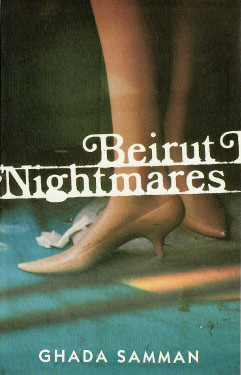
Beirut Nightmares - Ghada Samman


"When one's own homeland has 'emigrated,' leaving behind the values of humanity and social justice, how can any of its citizens be 'stable'?"


Set during the Lebanese Civil War in 1975, Beirut Nightmares is presented as a journal of a woman caught literally in the middle of the war.  Trapped in her apartment building where the war front has come and stalled, no one can escape; snipers are always seemingly present somewhere in the nearby buildings, waiting to shoot anyone who dares to appear outside.  Exactly whose side anyone is on is never clear; whether the author is Christian, Muslim, or something else in also kept hidden. 


The chapters are each presented as a separate nightmare, but are held together by the overall narrative.  While some of the chapters seem extremely real, others are not so obvious as to whether they are real or in the narrator's head.  Early on, she manages to sneak out at night to an adjacent pet shop that has been apparently abandoned but still full of animals in their cages.  She tries to help them by providing food and later escape, but finds that freedom is not so simple for the animals, just as it is not so beneficial for those trapped. 


Later on, the mannequins in stores along the street come to life; at first they are able to enjoy the restaurants along the avenue that have been abandoned by people, but soon they become victims of war just like everyone else.


A harrowing book, the best sections dealt with the narrator and her neighbors in the apartment below her as they slowly descend into panic and chaos.  Choices have to be made, but no one is there to help decide what is the best choice, or if there is a best choice, or if there is any choice.

The Bird Artist - Howard Norman


"I've never been all night anywhere but my own house," I said.

"Now you have."

"I'm going to have to explain it."

"Not to me."

"My mother, I meant.  My father."

"If we walk right up to your house hand in hand, stand right in the kitchen and ask for breakfast together, I bet they'll get the hint."


The bird artist is Fabian Vas, a young man living in Witless Bay, in the far reaches of Newfoundland in the early 20th century.  Fabian has been drawing since he was a young boy and is taking lessons, by correspondence, with a rather critical teacher who is sparse with compliments but who does seem to suggest that Fabian does have talent.  The village of Witless Bay is populated with the odd sorts you might expect in a remote village (think Northern Exposure, which was out at about the time this book was published) by the sea.  Fabian lives with his parents, who seem to mostly endure their marriage rather than enjoy it. Fabian has a puzzling relationship with Margaret Handle, who is a bit older than Fabian, drinks a lot, and is the dominant half of their relationship.  Fabian's passivity is, in fact, the distinguishing feature of his life. 


It seems the unchanging inflexibility of life in Witless Bay is a motivator, primarily for the women in this book, to seek, or inspire, change in the men in their lives.  Both Margaret and Fabian's mother, Alaric (his father is Orkney; odd names are a staple of life here), end up sleeping with the menacing lighthouse keeper Botho August.  Their motivations for doing so are intertwined;  Alaric is dissatisfied with her married life and Margaret is dissatisfied with Fabian, who has, essentially by providing no resistance, agreed with a marriage to his cousin (who he has never met) set up by his parents.  Alaric is not fond of Margaret.


The result of all this is a murder, the breakup of a family,  the beginning of an outlaw legend, and the growing up of Fabian.  And the making of an artist.  This is a decidedly peculiar book;  I have reread it several times, just for sheer enjoyment.  Margaret is an odd, at time frustrating, but always interesting character, as is Orkney, who seems to find himself in a most unconventional way.


Howard Norman has written 2 other books that I have read, The Museum Guard and The Haunting of L. Both take place in early 20th century Canada and include similar themes to The Bird Artist.  While I was less taken with them, they are both excellent.

The Fortress of Solitude - Jonathan Lethem


“What age is a black boy when he learns he's scary?”


Dylan Ebdus grows up in 1970's Brooklyn, one of the only white children in his run down neighborhood.  His father is a reclusive avant-garde artist, working on an film project that will never be completed; his mother Rachel runs off with another man early on in the book.  Inasmuch as that is completely at odds with the way I grew up, I related to Dylan like few other fictional characters I have been acquainted with. 


Lethem throws a ton of pop culture from the 70's and 80's at you over the course of this sprawling book.  Dylan acquires a love of comic books from the man Rachel ends up with.  Besides providing the title of the book, this also leads Dylan to Mingus Rude, the son of a faded, drugged soul singer, who becomes Dylan's best friend growing up.  Though, in a book that is exceptionally keen to the unspoken rules of race relations, there are always qualifiers on their friendship.  Even after Dylan grows out of his dorky white kid early years, he still will be an outsider in his own neighborhood.


There's so much going on in this book - Rachel, though she is gone, remains a presence in Dylan's life for many years through the postcards she sends, always encouraging Dylan.  His father, who, despite living with Dylan and being his sole means of support, is almost a non-existent part of his life, holed up in his room working on his project.  In order to support his son, he eventually accepts some work designing covers of science fiction novels and despite himself, becomes celebrated in that community.  Dylan and Mingus traverse their separate paths through adolescence and their teen years, sometimes together, sometimes apart.  There's always music to bring them together, along with the comic books and tagging.  Dylan also comes into possession of a magic ring.  In a nod to experiencing the other's life, he ring makes Dylan invisible, while it allows Mingus to fly and reach unreachable heights.  Each has their own path to follow, emblematic of the differences in opportunities available to each because of their skin.  Dylan, through the help of a teacher, ends up getting admitted to Stuyvesant High, a academically rigorous high school, and eventually Camden College (the fictional college of a bunch of novels, and which seems to shift novel to novel between Vermont and New Hampshire, and sometimes goes by Hampden, depending on the writer).  Dylan develops a drug habit (its the 80's, so cocaine is the choice), while Mingus remains back in the old neighborhood, and is a dealer for the same. 


As with real life, its the dealer, not the user, who gets in trouble with the law (or is it the black, not the white?), and Dylan carries out a wild attempt to free Mingus from prison that does not go exactly as planned, and mainly reinforces the guilt Dylan feels.


This is a story where I was fascinated with the details, populated with people who care about the same things I did and still do.  While fully integrating into one giant melting pot seems at times impossible, we are much better people for making the attempt to try and break down walls and mix with one another.

Monday, July 11, 2016

The God of Small Things - Arundhati Roy


“There are things that can be forgotten. And things that cannot - that sit on dusty shelves like stuffed birds with baleful, sideways staring eyes.”


I read this not long after it came out in the late 90's. As a dive into international literature, it wasn't particularly easy - my knowledge of India isn't the greatest and a lot of this takes place in the late 1960's and involves issues relevant to India at the time, but not necessarily ones that were international.  It did help to read up on some of the background issues here.  Then again, this novel hits on universal themes.  Failed relationships and the resulting impacts being a big one.  The God of Small Things is a beautiful read; this is Roy's only novel (she is involved in a lot of social activism), but she has a particular voice - there's a dreamy quality to the writing in which I felt I was getting a very impressionistic idea of what was happening.  There is a hard story going on as well, but she prefers to put a veneer over it, possibly due to going back in time.  It's very effective.


This revolves around a relatively well off family in southern India.  Ammu, the daughter who left to escape the tyrannical father, only to get married to an abusive, alcoholic man in Caluctta, has returned home with her twins, Estha and Rahel, who are seven as the story begins. Ammu's father has died, and her brother Chacko has returned from England (after divorcing his British wife) to run the family business (pickles).  Also living there is her aunt, Baby Kochamma, who early in her life had converted to Catholicism in an ill-fated attempt to attract a Catholic priest who had come to their village.


Chacko's ex-wife comes to visit from England with their young daughter Sophie Mol.  With the splintered family now back together, at least physically, events begin to transpire.  Estha is molested in a bathroom while they see a musical.  Ammu enters into a discreet affair with Velutha, a low caste handyman working at their farm, who is adored by both Estha and Rahel.


Eventually the affair is discovered and Estha, Rahel and Sophie run away to tragic consequences that are only compounded by the lingering bitterness in all the family members.  The novel eventually returns to the present day in which the long separated twins reunite, but only after suffering much the same fate as their elders.


Saturday, July 9, 2016

Between the World and Me - Ta-Nehisi Coates


“It is not necessary that you believe that the officer who choked Eric Garner set out that day to destroy a body. All you need to understand is that the officer carries with him the power of the American state and the weight of an American legacy, and they necessitate that of the bodies destroyed every year, some wild and disproportionate number of them will be black.”  


An odd discussion I had with my wife regarding this book.  She felt it lacked a unifying cry to do something together, as a group.  She is correct, that is not included here.  Possibly Mr Coates does not know what that something is.  But I do not think his intention was to include a solution.  I'm not sure he sees one.  The failure of this country to come to terms with its dark side, past and present, is something I consider on a daily basis and have failed to ever come up with my own answer or even a way forward.  I know that in the 50 odd years I have been here, many substantial progresses have been made, yet we still are at the starting line.


As I write this, the news is filled with another black man killed by police while pinned to the ground. I do not know how many others have been killed without such notice since the last time such a story was national news.  Reading this book has not made me more aware of this ongoing destruction, but it has made me more sensitive to the desperation and hopelessness of it.  In light of recent mass murders, the push to have armed citizens seems to be increasing.  Beyond the incredible notion that introducing more weaponry into a society that is already the most heavily armed by a huge factor, there is an hideously ignored racial factor.  The man killed today had a gun in his possession and early indications are that that gun caused his demise.  This is one of the primal fears in a white world: a black man with a gun.  For the police it can represent a way out; he may have used it against us, thus we had to do it.  While I have no doubt that the increased carrying of weapons by citizens will lead to more death, I also have no doubt that armed black men will also become more common victims because they represent a danger.

update 7/9/16.  And it continues.  All Lives Matter is a hypocrisy, a lie.  Just as the sky is blue fails to take in all aspects, the hurried and mumbled all lives matter does likewise.  A bomb in Baghdad a week ago takes the lives of 200...300? we don't even know the number and it barely registers on our conscience.  The killing of 140 in France brings much more concern, the radius involved to touch our lives is that much closer.  50 killed at a gay nightclub in Orlando is even closer, the fear begins to seem real. How much lives matter is a function of identification.  All lives matter seeks to blunt the hardening of our hearts.

Black Lives Matter.  Whether we begin to see that is still just a hope.

Thursday, July 7, 2016

A Wild Sheep Chase - Haruki Murakami


"She’d become so beautiful, it defied understanding. Never had I feasted my eyes on such beauty. It transcended all concepts within the boundaries of my awareness. She was at one with her ears, gliding down the oblique face of time like a protean beam of light.

"You are extraordinary." I said after catching my breath.

"I know." she said. 'These are my ears in their unblocked state."


I get to say that I was reading Murakami before he became so wildly popular in the US.  This was the first book of his that I read, sometime back in the early 90's.  As I recall, I was trying to find Hard Boiled Wonderland at the library, but this was available instead.  But this was good enough to get me hooked.


Describing a Murakami novel is always a challenge - both in terms of plot and exactly how to categorize it.  Japanese magical realism, topped with a love of American detective fiction and fueled with a skepticism of modern Japanese society?  There is something that runs through all his work along those lines.  A Wild Sheep Chase has a more straightforward plot than a lot of his later work, not that it makes a lot of sense.


Our hero, who like many an early Murakami protagonist, is never named.  He's divorced and runs an ad agency with a friend.  Pretty typical Murakami guy - not particularly motivated, mostly just passing through life.  He gets a letter from an old friend, "the Rat," whom he has not seen in years.  It includes a photo that our hero uses in a magazine advertisement as a background.  Because of this he is contacted by associates of "the Boss," a shadowy influential political figure.  It seems that the photo includes a special sheep (identified by a star shaped mark on its back) that has supernatural power and this sheep has provided the Boss his power.  He needs the sheep back to maintain his influence, and possibly his life.  Our hero, along with his girlfriend with the alluring ears (another Murakami special) seek out the Rat.
The physical journey is less important than the mental (metaphysical?) one.  They end up in the mountains of Japan at an abandoned farmhouse with seemingly little to do until an odd man dressed as a sheep turns up.  I generally find it next to impossible to say what a Murakami novel is about, though undeniably there is a lot to be gained.  The closest I can come is to say his books allow you to appreciate your own world in a different perspective than you normally do.  Maybe we all need to allow our ears to be unblocked from time to time.